

Ecommerce has evolved rapidly over the last decade. What once required a simple online storefront now demands precise coordination between sales channels, warehouses, fulfillment partners, and accounting systems. As brands scale, operational complexity increases — and without the right infrastructure, growth often leads to inefficiencies rather than success.
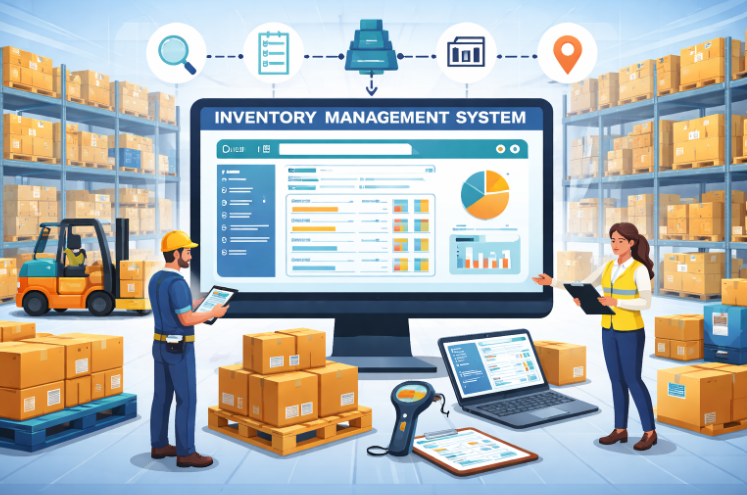
This is where a modern Inventory Management System plays a critical role. It serves as the operational backbone of an ecommerce business, enabling brands to manage stock accurately, streamline fulfillment, and maintain visibility across the entire supply chain. In this article, we’ll explore how the right system transforms ecommerce operations and supports sustainable growth.

Challenges Facing Growing Ecommerce Brands
Most ecommerce businesses start with basic tools like spreadsheets or the built-in inventory features of their ecommerce platforms. While these may work initially, they quickly become insufficient as order volume increases and operations expand.
Common challenges include:
- Inventory discrepancies across sales channels
- Overselling and order cancellations
- Poor visibility into stock locations
- Manual data entry and human errors
- Difficulty scaling fulfillment operations
Without a centralized solution, teams spend more time fixing problems than focusing on growth, which can limit scalability and overall operational efficiency.
How Centralized Inventory Visibility Benefits Ecommerce Operations
One of the most impactful advantages of a modern inventory solution is the ability to see all stock in one place. Instead of managing inventory separately for each platform or location, businesses gain a unified view across all warehouses and fulfillment partners.
This centralization allows teams to:
- Monitor stock levels in real time
- Track inventory movement across locations
- Make informed decisions about replenishment and promotions
With accurate and accessible data, businesses can operate proactively, reduce errors, and respond efficiently to changing demand.
Preventing Overselling with an Inventory Management System
Overselling is one of the most damaging operational issues for ecommerce brands. It leads to canceled orders, refunds, and frustrated customers — all of which hurt brand reputation.
A properly implemented Inventory Management System automatically syncs stock levels across all connected sales channels. When an order is placed, inventory is adjusted instantly, ensuring customers only purchase what’s available.
This accuracy not only prevents overselling but also builds trust, resulting in higher retention and repeat purchases.
Streamlined Order Management for Ecommerce Growth
Managing orders from multiple sales channels without a centralized workflow can create unnecessary complexity. Orders may be fulfilled from the wrong location, delayed, or processed incorrectly.
With a centralized order management solution, all orders flow into a single platform where they can be handled efficiently. Businesses can automate order routing based on stock availability, location, or fulfillment rules.
The result is faster shipping, fewer errors, and a smoother customer experience all without increasing operational overhead.
Automation and Efficiency with an Inventory Management System
Manual inventory updates and order handling are not scalable. As sales increase, manual processes become a bottleneck and a source of errors.
Automation built into a modern inventory platform reduces repetitive tasks such as:
- Updating stock levels
- Routing orders to fulfillment centers
- Creating purchase orders
- Managing stock transfers
This operational efficiency frees teams to focus on strategy, marketing, and customer experience instead of day-to-day firefighting.
Smarter Purchasing and Inventory Planning with Ecommerce Inventory Software
Inventory decisions directly impact cash flow. Overstocking ties up capital, while understocking leads to missed sales opportunities.
With accurate historical data and real-time insights, businesses can make better purchasing decisions and maintain optimal stock levels. At this stage of maturity, many brands transition from basic tools to ecommerce inventory software, which provides deeper visibility into inventory performance and demand patterns.
This data-driven approach helps brands reduce waste, improve margins, and operate more strategically.
Scaling Ecommerce Operations for Efficient Business Growth
Growth should not mean chaos. As ecommerce businesses expand into new markets, add SKUs, or partner with additional fulfillment providers, operations become more complex.
A scalable Inventory Management System ensures that new channels, warehouses, and workflows can be added without disrupting existing processes. This flexibility allows brands to grow confidently, knowing their operational foundation can support expansion.
Scalability is no longer a luxury — it’s a necessity for long-term success.
Seamless System Connectivity Through Ecommerce Integration Software
Inventory does not operate in isolation. It must remain aligned with ecommerce platforms, accounting tools, fulfillment partners, and third-party systems.
Modern inventory platforms act as a central hub that connects all these systems, ensuring consistent and accurate data across the business. Solutions like VentryHub function as ecommerce integration software, syncing inventory, orders, and financial data without manual intervention.
This connectivity eliminates data silos and creates a more transparent, efficient operation.
How VentryHub Supports Modern Ecommerce Operations
VentryHub is designed to help ecommerce brands overcome operational challenges by centralizing inventory, orders, and integrations into one unified platform.
With VentryHub, businesses benefit from:
- Real-time inventory visibility across all locations
- Centralized order management and automated fulfillment workflows
- Accurate inventory syncing across sales channels
- Seamless integrations with ecommerce, accounting, and fulfillment systems
- A scalable infrastructure built for growth
By replacing disconnected tools with a single source of truth, VentryHub enables ecommerce teams to operate more efficiently and make smarter decisions.

Final Thoughts
An Inventory Management System is no longer just an operational tool — it is a strategic asset for ecommerce growth. From improving accuracy and automation to enabling scalability and system connectivity, the right platform transforms how ecommerce businesses operate.
For brands looking to move beyond spreadsheets and disconnected systems, investing in a solution like VentryHub provides the control, visibility, and flexibility needed to succeed in an increasingly competitive ecommerce landscape.
Filed under